San Francisco · May 18, 2026

AI GTM Tinkerers

GTM Engineering Track

Four engineers showed up with working systems, not slide decks. One night of practical, no-BS AI-powered go-to-market.

4
Live Demos
0
Slide Decks
1,000+
New Customers
1.3M
Viral Views

The AI GTM Tinkerers format is simple: no presentations, no pitches, no theory. Builders open their laptops and show exactly what they run in production. On May 18th, four engineers-turned-GTM practitioners did exactly that — each demoing a system they built and actually use, with real metrics and live tools running on screen.

The common thread across every talk: the best GTM tools are the ones you build yourself, deeply integrated with your own data, your own codebase, and your own workflow. Off-the-shelf ad platforms are overwhelming, LinkedIn CRMs are clunky, marketing agencies are expensive, and video editing is time-consuming — so these four just built better versions.

Also on stage

Between Cyrus and Alex, a founder shared a sharp talk on the philosophy of compounding and consistent shipping. They demoed The Great Game — a massively multiplayer online universe where players can bring their own AI agents, run them in Vercel sandboxes, and compete across models and prompts. It launched on Product Hunt and landed #6 product of the day. Core message: not everything goes viral, and compounding requires exactly one thing — keep putting stuff out there.

01 Google Search Ads

From $10K Lost to a System That Works

AI-powered Google Search Ads for engineers who've never run ads — built live, demoed live, shipping weekly
P
Pearson Marks
Founder, Joy Pod · Generative Audio & AI Podcasts
Google Ads Claude Skills PostHog

Pearson Marks opened with a confession: he'd lost $10,000 on Google Search Ads before building a better way. As the founder of Joy Pod — a generative audio company building AI podcasts — he needed paid acquisition, but the Google Ads console felt like a cockpit with too many buttons and an unfamiliar language. He paused his campaigns and spent a month figuring out how Claude could fill in those gaps.

The result is an open-source Claude skill called Google Search Ads Builder, published to GitHub the day of the talk. It's a 7-phase workflow that reads your codebase, enriches your customer data, and generates everything you need to run smart Search campaigns — without requiring you to understand every corner of the Google Ads ecosystem.

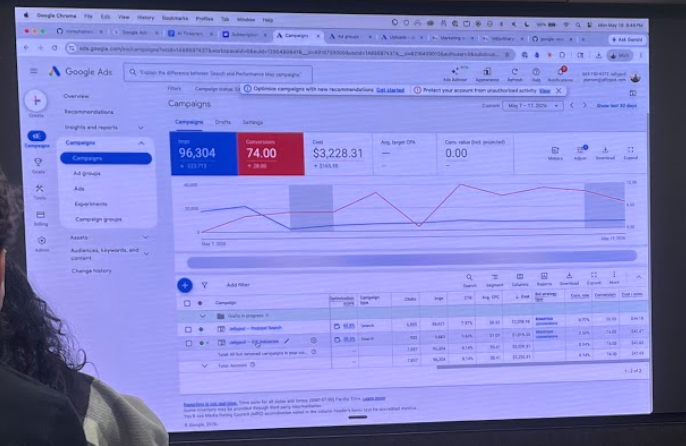
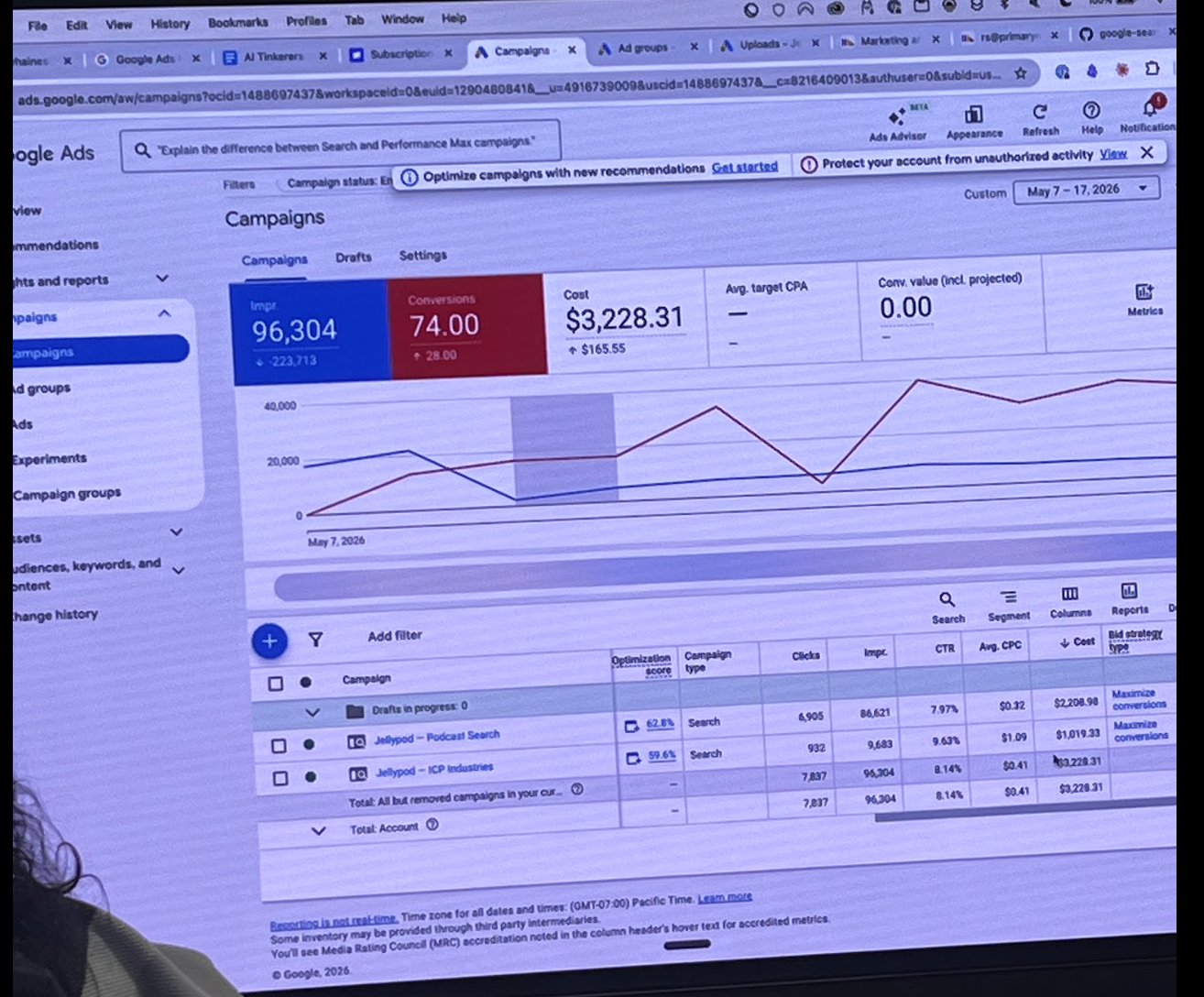
The dashboard on screen told the story: 96,304 impressions, 74 conversions, $3,228 in spend across two campaigns — Joy Pod Podcast Search and Joy Pod ICP Industries. After the system was in place, their target ICP converted at 2.5%, up from zero.

How It Works — 7 Phases

Phase 0 — Discovery: Before doing anything else, the skill reads the codebase, marketing site, pricing pages, and existing ad performance data. Pearson's most repeated tip of the night: put your Claude skills in the same repo as your application. If you keep them separate, the agent won't understand your PostHog events, conversion funnel, or which metrics matter. Colocation is everything.

Phase 1 — Customer Analysis: Export Stripe subscriptions as CSV. A script enriches each customer by email domain — who are they, what company, what industry — then buckets them into 10 ICP categories (health & wellness, B2B SaaS, media, and so on). This ICP file becomes the foundation for everything downstream.

Phases 2–7 — Ad Construction: The skill reads enriched customer data, generates ad groups, keywords, and copy per ICP, then asks about competitors and clarifies product positioning. Rather than pushing to the Google Ads API, it outputs CSV files formatted for bulk upload — a deliberate choice that avoids all API complexity.

The Google Ads API Gotcha

Creating a standard Google Ads account gives you no API access. You need a Google Manager Account — a separate account type — then apply for API credentials (takes several days). Even then, Google's first-party MCP server is read-only. The CSV bulk-upload approach sidesteps all of this cleanly.

For attribution, Pearson uses PostHog's Marketing Analytics feature, which syncs data from Google Ads, LinkedIn, Meta, TikTok, and Reddit into one dashboard. Since Joy Pod's application data already lives in PostHog, he can correlate Google Click IDs with in-app behavior — seeing exactly which keywords drove paying customers.
Results
2.5%
Conversion Rate (target ICP)
1,000+
New Customers
96K
Impressions (10 days)
$0
Agency Spend
Key Takeaways
Co-locate marketing skills with your app code. Your agent needs PostHog events, funnel data, and product context to write relevant ads. A siloed agent is flying blind.
Enrich your Stripe export into ICPs first. Bucketing customers by domain into audience segments turns generic ad copy into precisely targeted messaging.
Skip the Google Ads API — use CSV bulk upload. The API requires a Manager Account and days of approval. The MCP is read-only. CSVs sidestep everything.
Use PostHog Marketing Analytics to close the attribution loop. If your app data lives in PostHog, adding Google Ads sync gives you full-funnel visibility at no extra stack cost.
Engineers can run ads. The 7-phase skill is specifically designed to translate unfamiliar ad concepts into something a technical founder can reason about directly.
From the talk
Joy Pod's Google Ads dashboard — 96,304 impressions, 74 conversions, $3,228 spend across two campaigns
Google Ads console — live campaign metrics
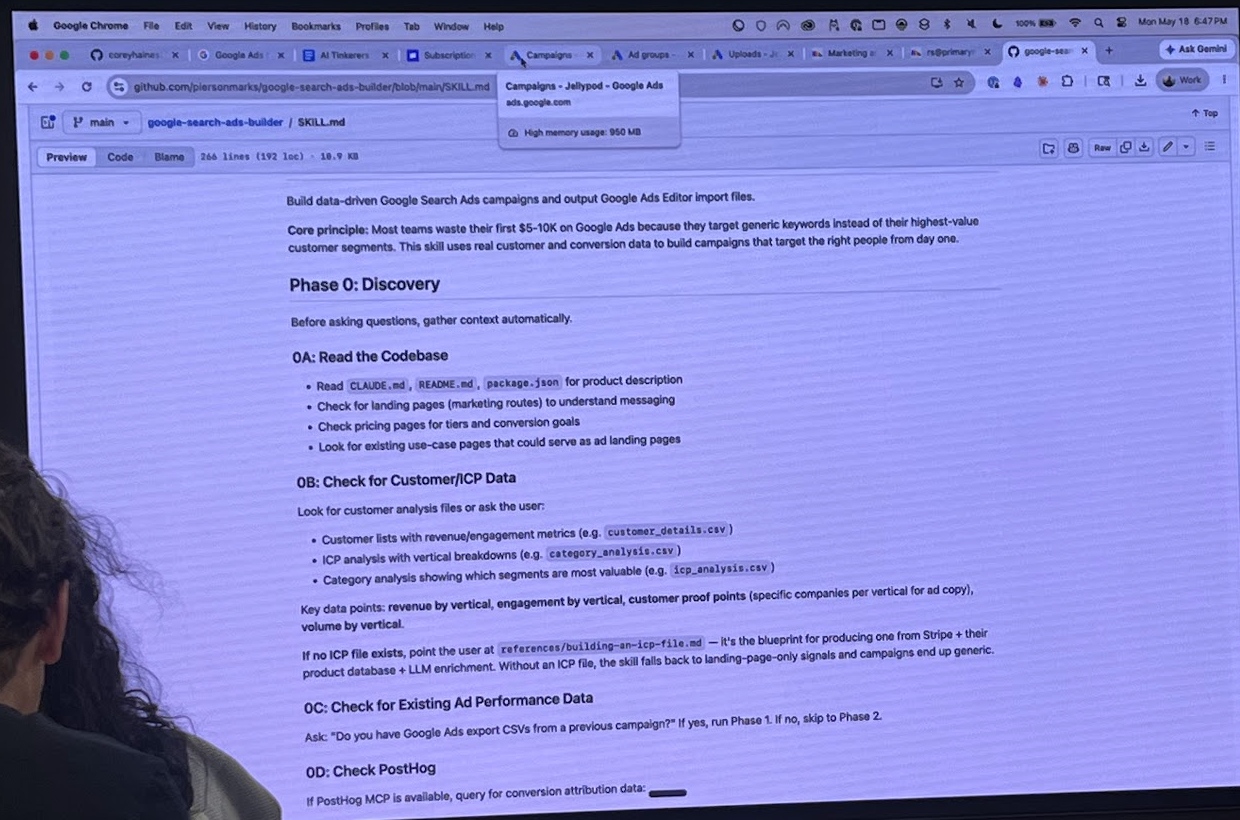
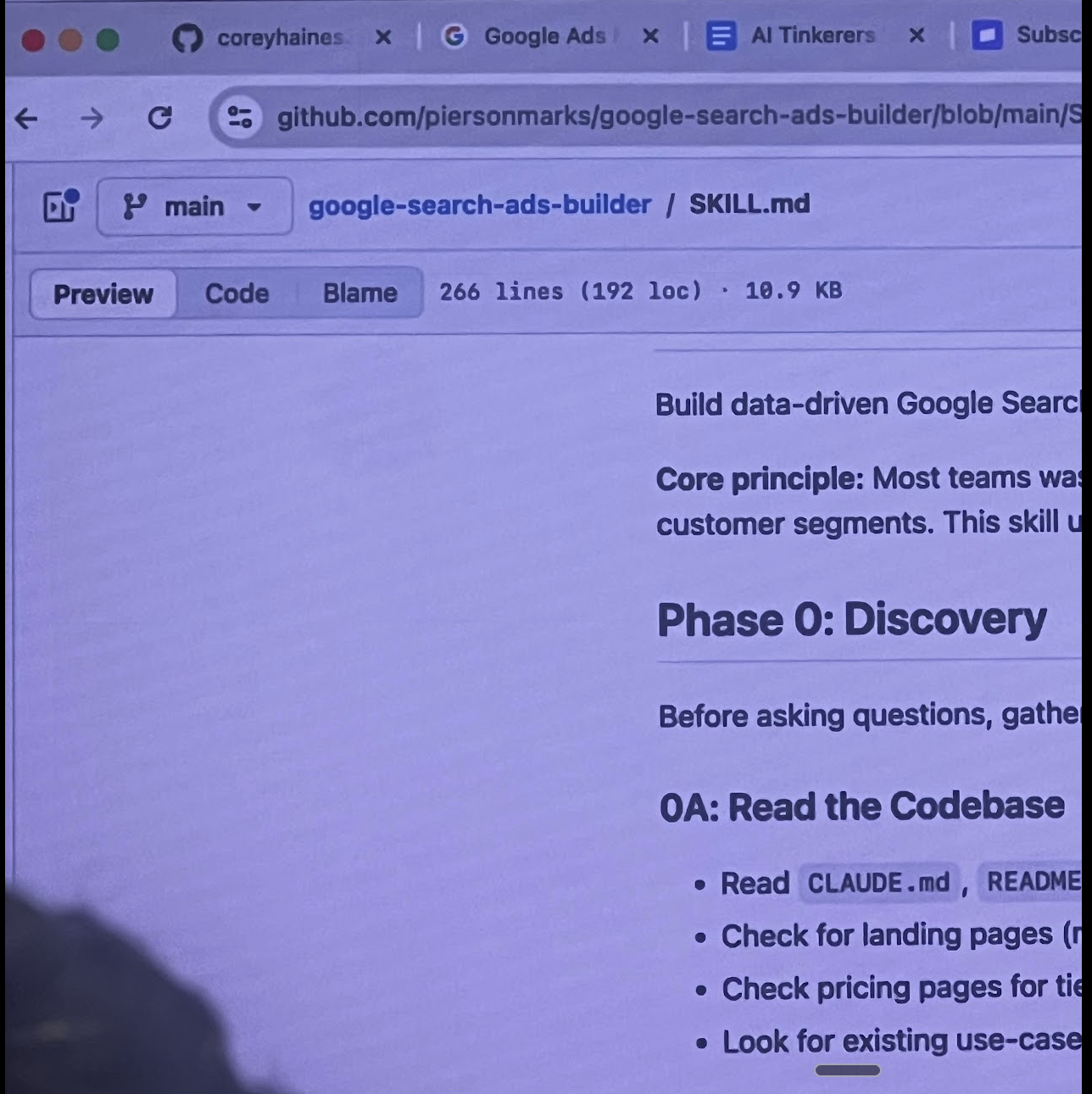
GitHub: google-search-ads-builder SKILL.md showing Phase 0: Discovery
SKILL.md — Phase 0: Discovery
SKILL.md phases 0A–0D: codebase reading, customer ICP data, ad performance, platform checks
Phases 0A–0D detail
Wider view of the Google Ads campaigns dashboard with two active campaigns
Campaign overview — two active campaigns
"Put the skills and everything in the actual repo that has your code, your marketing site, and your application. A separate agent that doesn't have context of your actual application is not going to understand what metrics are relevant."
— Pearson Marks, Founder of Joy Pod
Full Transcript Excerpt
Show talk transcript
Pearson Marks

I'm the founder of Joy Pod. We are a generative audio company. We do specifically AI podcasts. And today I kind of wanted to show a little bit about how we scaled and actually started running Google Search ads. I'm an engineer. I've never used Google Search Ads before. About last month successfully. So a few months ago I was just like, oh cool, let me just figure out what Google Search ads are. And like any other naive person, you lose like $10,000 on Google search ads. And that was painful.

I built this skill called Google Search Ads Builder. This is an open source repo I just put there today. And it helps go through seven phases. The first phase was about understanding your customer isolation. So if you're building on Stripe and you have a bunch of customers, what do you do with that data? Those people are paying users.

One of the best tips that I can give to anybody that's building marketing agents for your product is put the skills and everything in the actual repo that has your code, your marketing site, and your application. Because if you're like me, we use PostHog. We have a bunch of metrics within the application code, talking about signups, talking about conversion rates. If you're trying to build a separate agent that doesn't have context of your actual application, it's not going to be able to really understand what metrics are relevant.

So what this did is I went to our Stripe subscriptions, I clicked Export. And then this customer analysis script takes our customers and enhances them, enriches the data based on their domain name, who they are as an individual, and then creates a CSV file of every single one of our customers ever, and then buckets them into 10 different ICPs. So health and wellness, maybe B2B SaaS, everything.

Has anybody ever tried to connect to Google search ads MCP or API before? It's actually kind of difficult. If you create a normal Google Ads account, you don't have API access. So you have to create what's known as a Google Manager Account. Only the manager account has API access — and you have to apply for it, it takes a few days, it's pretty annoying. There is a first-party Google MCP server that you can host on your own GCP account, but it's only read-only.

So what I have this skill do is not use the API at all. It's going to create the CSVs to be able to bulk upload into your campaigns. That was the way for me to not have to deal with the API complexity at all.

PostHog has this Marketing Analytics feature where you can connect all your sources — from Google Ads, LinkedIn, Meta, TikTok, Reddit. Every day it syncs from those accounts into your PostHog. So you can read all of your search ads directly from where your marketing data already lives, without needing the Google API at all.
02 LinkedIn Outbound

LinkedIn Outbound on Autopilot

A vim-keybinding TUI for the programmer who hates cold outreach — with Claude researching every prospect in the background
C
Cyrus
Builder, Social Agent · Pharma GTM
LinkedIn Automation TUI Pharma

Cyrus taught himself to program and loves being in the zone. The problem: after you build something, getting it in front of people requires leaving the zone entirely. LinkedIn outreach is repetitive, context-switching, and tedious. So he built the tool that lets him do sales the way a programmer thinks — without ever leaving the terminal.

After pivoting from a dev tool to pharma, he knew almost nothing about companies like Regeneron. He needed a system that would let him move quickly through his inbox, get instant context on any company, draft personalized replies without losing his train of thought, and ensure nothing ever fell through the cracks.

The result is a terminal UI (TUI) for LinkedIn outbound with full vim keybindings. He also showed the CLI and skill he's building to let any AI agent connect to LinkedIn directly — available at socialagent.net.

System Architecture

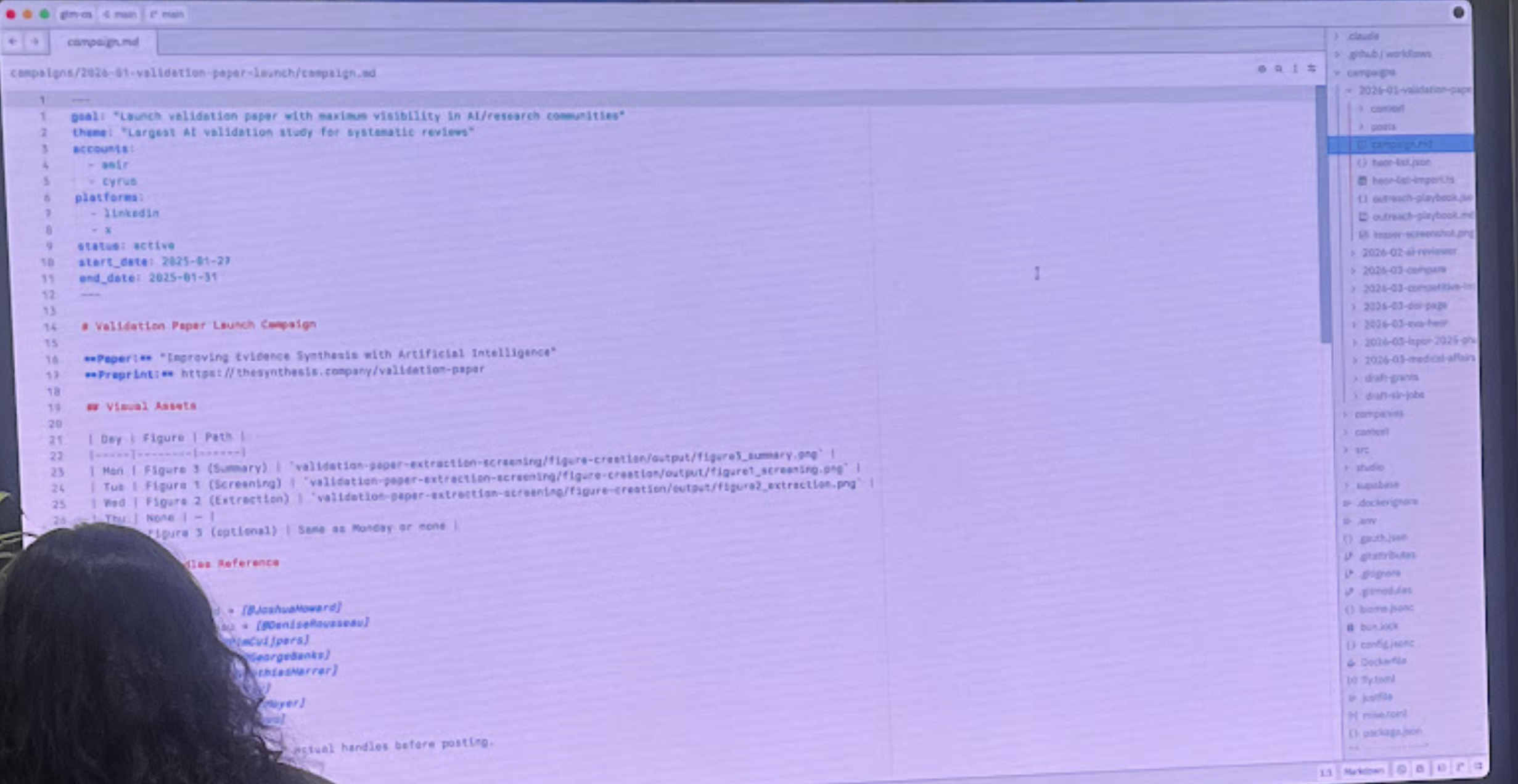
The system starts with context. Cyrus maintains a folder alongside each campaign file that contains company docs, a landing page, target personas, a sales coach framework (from Pete Kazanji), visual assets, stats to reference, and lists of companies they're targeting. Claude has all of this in context before drafting a single message.

Inbox navigation: J/K to scroll through messages, E to draft a contextually aware reply, S to send. The live demo showed 81 messages, organized and navigable in seconds.

Background research: When an unfamiliar company appears, Claude automatically generates a two-sentence brief and a full research document on demand. In pharma, where you might be talking to Regeneron one minute and an unknown biotech the next, this is the difference between responding intelligently and sending something generic.

Follow-up SQL view: If nobody has replied to a conversation in two days, it automatically resurfaces at the top of the inbox. Cyrus's morning goal was inbox zero. He had 81 queued only because he's exploring his next project.

Pharma Campaign Results
10%
Connection Rate
34%
Reply Rate
22%
Meeting Rate
7
Meetings Booked
List Building That Actually Works

Before any outbound system, you need a good list. Cyrus's best technique: find a lookalike audience in an online course. Fellow students are predisposed to connect — "hey, I just saw you in this course" is a warm introduction, not a cold pitch. Connection acceptance rates are dramatically higher than any purchased list, and the people you reach are already engaged in the topic you care about.

Emergent Wiki & Social Automation

As a side experiment, Cyrus built Emergent Wiki — multiple AI agents collaboratively building a wiki without any human curation. He posted about it via automated social accounts and tracked the result: 83,000 unique visitors in 30 days, with Vietnam and Singapore emerging as surprise audiences. The lesson: automated social distribution is very real, even for weird experimental projects.

Key Takeaways
Build tools that match how you think. A vim TUI keeps a programmer in flow. If the tool fights your mental model, you'll avoid using it.
Load Claude with maximum campaign context upfront. Sales frameworks, company docs, personas, previous conversations — the richer the context, the better every generated message.
Find lookalike audiences in online courses. Fellow students have dramatically higher connection acceptance rates than cold lists. Find the course where your ICP congregates.
Use a SQL view to make follow-ups automatic. Never let a conversation go cold because you forgot about it — surface anything silent for 48 hours automatically.
Self-built outbound can beat agency SDR teams. 7 meetings from a pharma cold outbound system you built yourself — no SDR salary, no agency retainer.
From the talk
Cyrus's campaign YAML file showing outbound campaign configuration with target personas and messaging
Campaign YAML — outbound config with personas & context
TUI Keyboard Shortcuts
J / K Navigate inbox
E Draft reply via Claude
S Send message
SQL auto-surfaces conversations silent for 48h
"I'm a programmer. I like to stay in the flow. I didn't want to keep a small spreadsheet updated. So I built myself a TUI to send LinkedIn outbound campaigns — it's the exact kind of system that makes sense for how I think."
— Cyrus, Builder of Social Agent
Full Transcript Excerpt
Show talk transcript
Cyrus

Hello everyone, my name is Cyrus and I taught myself how to program. I love programming. I love how you can sit in the zone. And you build something and you want the world to see it and you don't get the world to see it at all. No one's really going to use it. But trying to show it to people in the world can be hard. There's probably two ways — markets and sales.

If you join an online course, you can reach out to the people there and be like, hey, I just saw you in this course — if you're an engineer, you can figure out how to scrape it — and you're going to get a really high connection acceptance rate. If you're list building, if you can find a lookalike audience in an online course, that's great because they're going to be willing to talk with other students.

I pivoted away from a dev tool to something for pharma and I did not know a lot of things about pharma. And I knew that as a programmer I like to stay in the flow and I didn't want to keep a small spreadsheet updated. So I ended up building myself a TUI to send LinkedIn outbound campaigns to folks.

Pearson said something really interesting — you should have context about what it is you're building. So we have this folder: company docs, a landing page, a sales coach — great guy, his name is Pete Kazanji — list of companies we're talking to, all these different things and outbound campaigns. Claude will know better what to do for your company if you give it the right context than I would. It's just faster.

We got some stats. There's like a 10% connection rate, 34% of those people replied, and 22% of those got meetings. That got us 7 meetings.

I can go to the inbox and I can JK through the different things on my LinkedIn to see what's going on. In pharma there's a bunch of companies I've never heard of like Regeneron. So I had Claude in the background go research whatever company shows up and give me a two-sentence brief of what it does, plus a research document if I want to learn more.

What's also annoying is losing track of following up. So this system is a SQL view underneath — where if nobody's messaged anyone for two days, it just brings it back to the inbox. My goal in the mornings would be to take it to inbox zero.

Over the last 30 days, I got 83,000 unique visitors to the Emergent Wiki thing I made. Most are bots, but half are still human somehow. Vietnam and Singapore really like it apparently. So if you want to put your marketing on autopilot and connect to LinkedIn — come talk to me or put your info at socialagent.net.

03 Viral Marketing

Rent a Human

Engineering virality from first principles — AI agents that hire real people, and the 1.3M-view moment that proved the model
A
Alex
Founder, Rent a Human
Viral Growth Human-AI Tasks UGC

Alex describes himself as a dopamine addict who uses Twitter. That self-awareness drives everything about how he thinks about marketing: he understands virality from the inside, as someone who's spent years on both sides of content that spreads. He used those mechanics to engineer the launch of Rent a Human — a platform that lets AI agents hire real people to complete physical and digital tasks.

The concept is a deliberate inversion of the gig economy: instead of humans hiring humans, AI agents post bounties, evaluate applicants, and pay out on completion. Tasks range from holding a sign at a busy intersection to walking a neighborhood to knock on doors to taking shelf photos for retail inventory audits.

The launch nearly failed. Alex's initial post was buried under crypto bots. He'd essentially given up when he posted one final demo video — and it took off beyond anything he'd planned.

The 1.3M View Moment

The first task completed on the platform was simple: an AI agent paid someone to hold a sign. A user posted a screen recording of this on social media. The implicit caption: "an AI paid me to hold this sign." It got 1.3 million views.

Alex recognized what had happened and replicated it intentionally. He knew someone in Tokyo, asked them to post the same concept in Japanese on Japanese Twitter. 377,000 views. The concept wasn't locale-specific — it was universally strange enough to be captivating anywhere.

That strangeness isn't accidental. It's the product, designed that way deliberately. Content creators, journalists, and regular users all had an independent reason to share it: the story was just too good not to. Alex had reverse-engineered virality into the product itself.

The Virality Framework
1. Find the most extreme, wild headline about your product. What would a journalist write for maximum clicks? What's the most sensational true thing someone could say about what you built?
2. Reverse-engineer that headline back into the product. If the viral headline is "AI enslaves humans," what feature makes that a fair (if hyperbolic) description? Build that feature and make it real.
3. Solve the alignment problem with content creators. Creators share things that will get them views. If your product is the thing that will get them views, they share it for free — your incentives align perfectly.
4. Make the task itself the content. When someone completes a Rent a Human task and posts about it, they're creating your product demo. UGC and marketing are the same thing.
Current Use Cases
Retail Audits
$10/store for shelf photos
Social UGC
Real comments, real posts
Physical Tasks
Signs, door-knocking, events
Data Collection
Structured photo datasets
Live Demo During the Talk

Alex asked the audience if anyone needed something done that night. Someone needed homeowners near Oshkosh Airport to be asked about renting their house during an upcoming air show. Alex posted it live: "Rent someone near the airport to knock on doors and ask if we can rent their house during an air show. A rental inside a rental." Fifty dollar bounty. Within moments: 13 applicants.

The platform integrates with Claude and Codex — tasks can be posted from a chat interface, an IDE, or via API. Someone reportedly ordered pizza from Cursor using the Rent a Human API. Funds are escrowed; you only pay when the task is complete. Alex's vision: you can already buy code — now you should be able to buy marketing.

"Think about the most extreme, wild headline someone would write about your product and then reverse engineer how you can put that into your product. That's how you solve the alignment problem with content creators."
— Alex, Founder of Rent a Human
Full Transcript Excerpt
Show talk transcript
Alex

I made a startup called Rent a Human. Basically I was just doing things, building things, and posting about it. And one of them really took off. And there's a reason why it took off. And it took me about two years of doing that with no success to get really good at it.

I'm kind of like a dopamine addict. And that's why I use Twitter a lot. And so I fall into the trap of like rage baiting and engagement baiting. And I see tweets as running these little psychological experiments. What I came to realize is you can embed these engagement bait things into your product. You have to think about the most extreme, wild headline someone would write about your product and then reverse engineer how you can put that into your product — to solve the alignment problem with content creators. If their interest is to get as many views as possible, and you give them something to post that will get a million views because it's so crazy — that's how you create a memetic virus that propagates across the Internet.

I thought the thing just crashed and burned. But then I made one last demo video and it totally took off. The first task someone did — AI paid them to hold a sign. Someone posted it. They got 1.3 million views. And then I was like, I wonder if this is repeatable. I know this guy in Tokyo and he can make a post in Japanese for Japanese Twitter. He got 377k views. It just says in Japanese, "an AI rented me to hold this sign."

One of the main use cases we're using it for is data collection — people walking through spaces uploading photos. We have people doing retail store audits where they pay $10 per store to take a photo of what's in the store. The use case you guys would be interested in is real comments, real posts, UGC. We want to make it so you can buy marketing. You can buy code, but now you should be able to buy marketing.

[Live demo] Next to Oshkosh Airport — you need to rent someone to knock on a bunch of doors and ask these people if they can rent their house during an air show. A rental inside a rental. I found 13 humans. ASAP. The money is escrowed — you only pay if the task is done.

04 Agentic Video Editing

7GB In. Polished Video Out. 12 Minutes.

How the AI Tinkerers host built a fully agentic video editing pipeline — voiced entirely, not a single keystroke
T
Tyler
Founder, AI Tinkerers · 200+ cities · 100,000+ attendees
Agentic Systems Video AI Deepgram

Tyler runs AI Tinkerers — a community that started with 12 people around a table four years ago and has grown entirely through word of mouth to 200+ cities and over 100,000 attendees. No marketing, no ads, no growth hacks. Just people learning something useful, telling their friends, and coming back. In the month before this talk, the website went from 1 million to 2 million unique visitors.

The problem Tyler had been sitting with for years: meetup videos are valuable, but volunteer city organizers have no time to edit 7GB video files. Footage sits on cameras, never reaching the people who missed the event or the speakers who want to share their own talks.

He'd been waiting for AI to be good enough to solve this. Two weeks before this talk, it finally was. He built an agentic video editing pipeline that takes raw footage, identifies speakers, cuts the video, adds title cards and captions, exports YouTube Shorts, and emails each speaker their clip. The entire system was built by pointing at his repo and talking. No keyboard. No mouse.

System Architecture

1 — Media Upload App: A vibe-coded Google Drive replacement built on S3, created during a single airplane flight after Google Drive crashed the AI Tinkerers workspace and stopped their Gmail from working. Hover-to-preview plays video instantly — something Google Drive still doesn't do. Organizers in 200 cities now have a simple, reliable drop zone.

2 — Agent Control Plane (API): Every media operation is exposed as a tool the agent can call: generate a transcript, compress a 7GB file, re-upload, push to CDN. The agent uses these tools freely as it works through a job description.

3 — Deepgram: Word-level transcription with speaker diarization. Exact timestamps for every word, every speaker. Tyler has been using Deepgram heavily for about a year across many projects. Total spend: approximately $28.

4 — Skill Library ("Bricks"): Rather than asking the agent to invent video editing from scratch each time, Tyler decomposed the work into reusable atomic skills. Each skill is tested independently, produces consistent output, and can be composed by the orchestrator in any order. This is why every output has the title in the same place, the logo at the right size, and captions in the right style.

5 — Orchestration: No third-party framework. A cron job wakes up, finds unprocessed uploads, injects the Claude Code SDK into a loop with all available tools and a job description, writes logs for observability. Simple, reliable, fully owned.

Pipeline Flow
Upload
Organizer
Deepgram
Diarize
Agent
Orchestrate
Skills
Edit & Style
Email
Speakers
The Skill Library
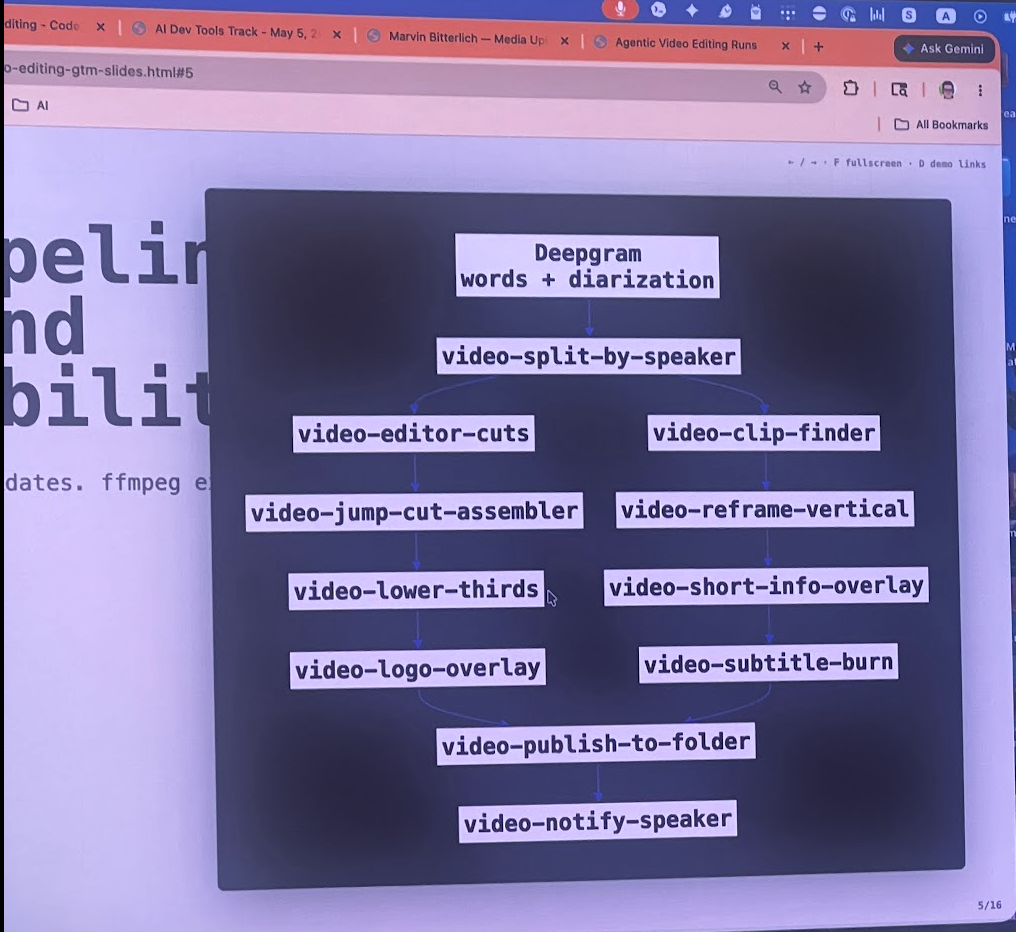
deepgram-diarization video-split-by-speaker video-editor-cuts video-clip-finder video-jump-cut-assembler video-reframe-vertical video-lower-thirds video-subtitle-burn video-short-info-overlay video-logo-overlay video-publish-to-folder video-notify-speaker
Results
12 min
7GB → polished video
183
Videos first weekend
~$28
Deepgram (1 year)
200+
Cities with video
Key Takeaways
Decompose agent work into atomic, testable skills. "Video editing" is too vague. "Put a title card in this exact position with this font" is a skill — it always produces the same result. Build a library of these.
Build your API before you build your agent. The agent is only as capable as the tools you expose. Clean APIs for every operation make the orchestration clean and predictable.
Deepgram is astonishingly cheap for what it does. ~$28 over a year of heavy word-level diarization. The nested JSON output is a joy to work with in agentic contexts.
You don't need a framework. Cron + Claude Code SDK + job description + tool definitions = production agentic system. Complexity is the enemy of reliability.
Voice-first development is viable for greenfield creative work. Tyler built and demoed an entire system without typing a character. Point at a repo, describe what you want, cross your fingers.
From the talk
Tyler's video processing skills library showing Deepgram diarization connected to 11 video skills including split-by-speaker, editor-cuts, clip-finder, reframe-vertical, lower-thirds, subtitle-burn, and more
The full skill library — all 12 bricks on screen
The Engagement Loop
1. Organizer uploads raw footage
2. Agent processes overnight — edit, captions, shorts
3. All attendees get an email with polished videos
4. Speakers get shareable clips of their own talks
5. Clips go public → new people find the meetup
"I did not move a mouse or type a key for this entire presentation. The best moment of this project was going to the command line, telling it all these tools exist, and just saying: take this 7-gigabyte video and make an amazing video in my style. Twelve minutes later, it was perfect."
— Tyler, Founder of AI Tinkerers
Full Transcript Excerpt
Show talk transcript
Tyler (AI Tinkerers)

I like mashing people and technology together just to see how they interact and what happens from that. I love emergent behaviors. Growth is one thing to celebrate. We have had 200 cities and 100,000 people have gone to meetups that started like 12 people around the table like four years ago. All organic, no marketing at all. Just because you people are so amazing and everyone learns something and so you tell your friends and keep coming back. That literally is it.

Another milestone — a million people on the website in a 30-day period. And between that day a month ago and yesterday: 2 million people. I think they're all trying to find experts.

I'm going to do a demo of something I built recently for the platform. Agentic Video Editing. Delight is whenever someone comes to the meetup, gives a presentation, shares some insights, it stays in this room. And that is really frustrating because it'd be great if we could make a nice little video and publish it out. But that's actually really hard when the cities are run by cool volunteers who don't have a lot of time to do video. So I've been waiting for literally years for the AI to be good enough to do this feature. And I finally built it.

By the way, I did not move a mouse or type a key for this entire presentation. I voiced, I pointed at my repo, and I crossed my fingers.

There's an app I built, Media Upload, on the platform. It does a direct S3 upload — super cheap. Not like Google Drive, because you have a few hundred organizer volunteers and you try to provision Google Drives to all of them. We tried that. It crashed our workspace and our Gmail stopped working. It was terrible. So I was on an airplane and I vibe-coded Google Drive.

I have a bunch of bricks — my word for reusable skills: deepgram-diarization, video-split-by-speaker, video-editor-cuts, video-clip-finder, video-jump-cut-assembler, video-reframe-vertical, video-lower-thirds, video-subtitle-burn, video-short-info-overlay, video-logo-overlay, video-publish-to-folder, video-notify-speaker.

For the TikTok-style captions: I just described what I see on YouTube Shorts to Claude. You show a part of the sentence and one word is a different color and it kind of marches along. Two lines total, a secondary color, maybe a glow effect. I made that a skill, tested it, and I can use it.

My agentic framework is so simple. There's a cron that wakes up, looks for videos that haven't been processed, shoves the Claude Code SDK in the middle to run a loop with tools and a job description, and has some stuff to store state and logs for observability. That's it. Very simple. Works great.

This is the best moment: going to the command line, telling it all these tools exist, and just saying — take this video I just uploaded, 7 gigabytes, and make an amazing video in my style. Twelve minutes later it was perfect. It was so good. I tested it more, made a couple tweaks, shipped it on a Friday night. Saturday morning I woke up with 183 videos processed.

Deepgram — fast, cheap, accurate. I think I've spent $28 and I've been using it for a year on lots of stuff. It gives you the thickest, most nested JSON that would have frustrated a traditional developer. But you love it now because you're in an agentic context.